The VCS Test - mold screening tool
- Jul 15, 2025
- 6 min read
This test is a free tool you can take at home if you suspect mold, Lyme, or another biotoxin-related issue might be affecting your health. If you'd like to pursue other testing for mold and biotoxins, please reach out and I can help you get those ordered & interpreted.

The Visual Contrast Sensitivity (VCS) test is a quick, online screening tool that looks at how well your eyes and brain work together to detect light vs. dark patterns. Specifically, it assesses function at the level of the retina, optic nerve, and visual cortex, which are part of your central nervous system (CNS). It helps to determine whether your brain is receiving and processing visual input properly, something that can get disrupted by toxins, infections, or neuroinflammation (swelling/inflammation in the brain).
The test itself is simple: you click through a series of faint striped patterns and indicate which way you see the lines leaning. It takes 10–15 minutes, and results are instant.

It was developed by the military
The U.S. military originally designed this test to detect neurological effects of chemical and bioweapon exposure in soldiers. The pioneering mold doctor Richie Shoemaker later adapted it for use in environmental medicine, after seeing a consistent pattern of VCS loss in patients with mold illness, Lyme, and other chronic inflammatory conditions.
It's a screening tool
The VCS test is part of my screening process. I request that any client who has spent time in a moldy or water damaged building take it, and also add it when clients are dealing with symptoms like:
↣ Fatigue
↣ Brain fog
↣ Dizziness or light sensitivity
↣ POTS
↣ MCAS
↣ Anxiety
↣ “I’ve tried everything and still feel awful”
These symptoms are common symptoms of hypothyroidism and Hashimoto's, but sometimes it's not the thyroid! And I've found that mold and infections like Lyme can be the underlying triggers for autoimmunity, so screening this way is part of my process. It's free (for the first test), easy to repeat, and often gives us that first breadcrumb pointing toward total toxic burden, mold exposure, or infection-driven inflammation.
What the results mean
A failed or “positive” VCS test doesn’t give you a diagnosis. It just tells us your visual processing is impaired, often due to neuroinflammation. It will tell you your score, show you a graph, and give you explanations on how it calculated your score. Here's mine when I was first dealing with mold:

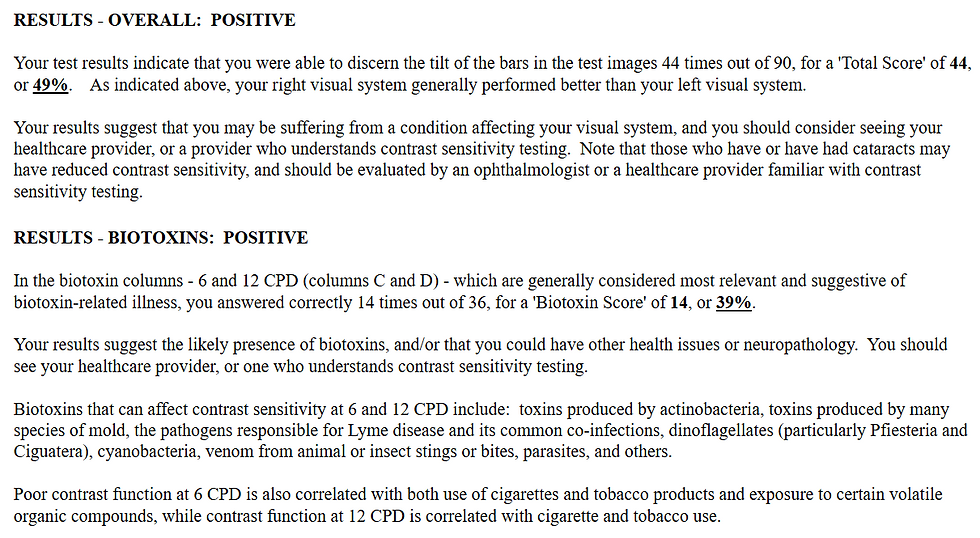
It will also tell you if nutrient deficiencies may be at play.

The most common triggers behind a positive test include:
✔ Mold and mycotoxins
✔ Lyme disease and co-infections
✔ Mercury or other heavy metal exposure
✔ Solvents or chemical toxins
✔ In some cases, TBI or neurodegeneration
✔ Nutrient deficiencies
Is it actually clinically useful?
There is a common pushback: “It’s just nervous system dysregulation”
There’s a claim floating around wellness spaces that any nervous system dysregulation can cause a positive VCS test, so it doesn’t really mean anything. Yes, extreme stress or nervous system dysfunction might make someone feel scattered or miss a few patterns on the test. But there’s no good evidence that trauma alone or dysautonomia by itself creates consistent VCS failure unless there’s an underlying inflammatory or toxic driver.
Nervous system dysregulation might affect test performance, attention span, or reaction time, but contrast sensitivity loss (which is what the VCS actually measures) usually reflects physical neuroinflammation or toxicity affecting how your brain receives and processes visual signals
If someone fails the VCS and also has mold exposure, mycotoxins on lab testing, or symptoms that line up with biotoxin illness, it’s not a coincidence. It’s a useful clue!
My personal experience
This was one of the first things that tipped me off to how serious my toxic load was (you can follow along on my mold illness story on my TikTok). During my mold illness, I failed the VCS badly (see above). After working through detox protocols, the test normalized, and I felt like I had my brain back! You can see the graph of my scores over time. Check out that dip in 2024, though...

After a Lyme diagnosis and COVID infection, I took the test again after not taking it for a while and failed it. In hindsight, I believe the virus kicked up some inflammation, along with my underlying Lyme and co-infections I was working on. I continued treatment, supporting my drainage pathways and nutrition. As you can see, the test went back to normal again (See my most current results below)!

That’s why I don’t just use it once. I’ve seen how the VCS can track progress and reflect real-time shifts in neuroinflammation. It's really convenient to use to keep track of how things are going! After the first test, you do have to make a donation to retest (they have scholarships available if you can't afford it), but it's around $25-$35 a test, and cheaper if you buy a bundle of credits to use over time.
When a normal result doesn’t mean you’re fine
Some clients pass the VCS test even when they’re clearly dealing with biotoxin illness. That’s not uncommon, especially if:
They’ve been out of exposure for a while
Their symptoms are more gut/hormone-driven than neurological
Their toxic burden is high, but they haven’t triggered inflammation yet
They've recently added a questionnaire to the VCS Test going over the signs of CIRS (chronic inflammatory response syndrome), which is a diagnosis that covers biotoxin illness. It tells you how many symptoms are consistent with that diagnosis, which adds another layer of usefulness to the test. So while I never use this test in isolation, it can give us a valuable piece of the puzzle and helps us know if we need to look further into biotoxins.

How to take it
If you’re curious, here’s where you can take the free version I use with clients (and myself):
Follow the easy instructions on screen and you'll have your results in a few minutes! Screenshot your results, as the free test doesn't give you a downloadable copy (you can upgrade your results at any time if you want to be able to save the pdf).
What to do if it’s positive
Don’t panic! It might mean your brain is dealing with a toxic or infectious burden that’s worth investigating.
Some next steps may include:
↣ Starting with gentle binder support to help move the toxins out of your system
↣ Running a Mycotoxin test or Total Tox Burden panel (mold, metals, pathogens)
↣ Considering Lyme/co-infection testing if symptoms point that direction
↣ Looking at drainage, detox capacity, nutrients, and inflammatory load
If you test positive and need help ordering a mycotoxin test or total tox burden test, I offer that service, along with interpretation and support plans. Reach out here or check my website for details.
Mold exposure and histamine reactivity overlap more than most people realize. If you're dealing with symptoms that don't have a clear explanation, the quiz can help you see whether histamine is part of the picture. Take the quiz →
Want to understand the connection better? I cover mold, histamine, gut, and thyroid in my weekly newsletter. Join the newsletter →
Jennifer Scanlon, MS, FDN-P, holds a Master of Science in Holistic Nutrition and a Bachelor of Health in Cardiopulmonary and Diagnostic Sciences. Before starting her nutrition practice, she spent more than a decade as a respiratory therapist working alongside physicians and nurses as part of the critical care team. Her role included neonatal resuscitation, ventilator management, blood gas analysis, and the assessment of critically ill patients, providing a strong foundation in physiology and clinical reasoning.
After facing her own health challenges that weren't fully explained by conventional testing, Jennifer returned to graduate school, completing her master's capstone on Hashimoto's disease and the gut-thyroid connection. She has since pursued advanced training in functional health assessment and spent years studying thyroid disorders, gut health, iron deficiency, histamine intolerance, MCAS, and the complex interactions between body systems.
Today, Jennifer helps women uncover potential contributors to symptoms that often fall through the cracks of standard evaluations. Her approach combines nutrition, lifestyle factors, functional testing, and conventional lab data to identify patterns and connect the dots between thyroid, gut, histamine, and hormone issues, helping women make sense of symptoms that are often dismissed when standard lab work comes back "normal." Visit the website here.
Disclaimer: I do not diagnose, treat, prevent, or cure any disease or condition. Nothing I share with my clients is intended to substitute for the advice, treatment or diagnosis of a qualified licensed physician. I may not make any medical diagnoses or claim, nor substitute for your personal physician’s care. It is my role to partner with you to provide ongoing support and accountability in an opt-in model of self-care and any changes should be done under the supervision of a licensed physician.


Comments